Publications
-
Deflectometry is a versatile optical testing tool used in various fields, from astronomy to industrial applications, due to its non-null testing capability which facilitates precise measurement despite challenging optical surfaces and system layout constraints. In this manuscript, we present novel variational advancements to traditional deflectometry, towards universal functionality and system friendliness. Traditional dark-field illumination is an inspection technique that is sometimes used to detect particles on a specular surface. Problems arise in its repeatability, as an intensity-based measurement is vulnerably dependent on the testing conditions of time, limiting its ability to be used in automated fashion. The first advancement leverages phase algorithms commonly seen in deflectometry; by adding a secondary light source (normal to the surface) and modulating each source's intensity with a time-varying sinusoid. The phase-based information has a higher sensitivity to the light scattered from a defect producing a more robust computational image process method that is now insensitive to the environment. The second advancement is an alignment method to obtain lower-order shape. While deflectometry proves effective in measuring mid-to-high frequency surface shape, it faces challenges when assessing low-order shape measurements like power, astigmatism, and coma due to relative position and alignment error between the unit under test (UUT) and the deflectometry system. To avert the necessity of additional instruments like a coordinate measuring machine, laser trackers, or interferometers, we leveraged computational fiducials and sensitivity matrices to identify and address misalignments effectively. With enhanced capabilities and system-friendly features, our advanced deflectometry techniques provide powerful options in optical testing. By addressing the challenges in low-order shape measurements and incorporating dark field testing, our approaches extend the potential of deflectometry as a valuable tool in optical metrology across a broad spectrum of industries and scientific endeavors.
-
In an effort to produce a more efficient optical system designers have begun to shy away from the traditional `spherical' lens, favoring freeform surfaces which correct for more aberrations, thereby allowing for a more compact system. The challenge now is determining how reliably these components can be manufactured, which requires a tool capable of accurately measuring them. We expand on previous phase measuring deflectometry techniques to enable the measurement of high-sag freeform optics by recording the difference in measured phase values. In this paper we justify the need for these changes by demonstrating where current approximations fall short, and a more generalized solution is derived. A system incorporating these changes was built to measure a high-sag freeform surface, the entire curved portion of a Samsung Galaxy S8 phone in single pass. We demonstrate our method is capable of determining deviations from an expected surface figure which makes it ideal for an industrial setting where quality control and consistency are critical.
-
Dark-field illumination is a simple yet elegant imaging technique that can be used to detect the presence of particles on a specular surface. However, the sensitivity of dark-field illumination to initial conditions affects its repeatability. This is problematic in cases where automation is desired. We present an improvement to the current method of using a modulation field that relies on phase calculations rather than intensity. As a result, we obtain a computational method that is insensitive to noise and provides clearly defined particle information, allowing a global threshold to be set for autonomous measurement purposes. After introducing the theory behind our method, we present experimental results for various scenarios and compare them to those obtained using the dark-field approach.
some old projects
-
![]()
-
![]()
-
![]()
Spartan Hyperloop
The Hyperloop Pod Competition was an annual competition sponsored by SpaceX from 2015 to 2019 in which a number of student and non-student teams participate to design—and for some, build—a subscale prototype transport vehicle in order to demonstrate technical feasibility of various aspects of the Hyperloop concept.
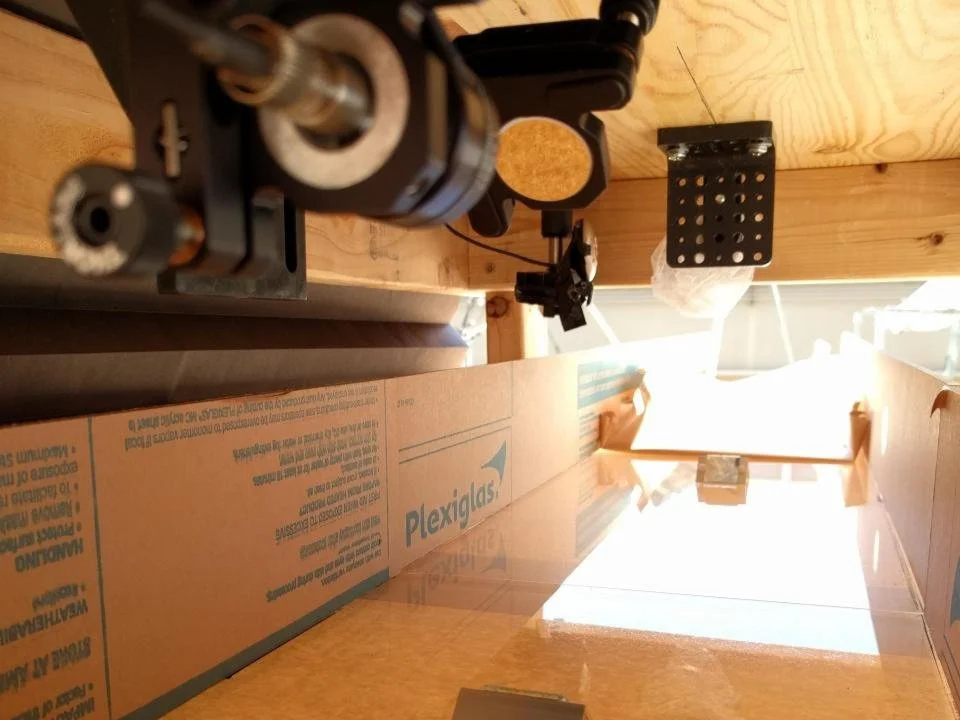
I designed and built an interferometer using geometry of a Lloyd's Mirror. Allowing for measurements to be taken outdoors and in real time.
-
![]()
-
![]()
524 Case Study 2
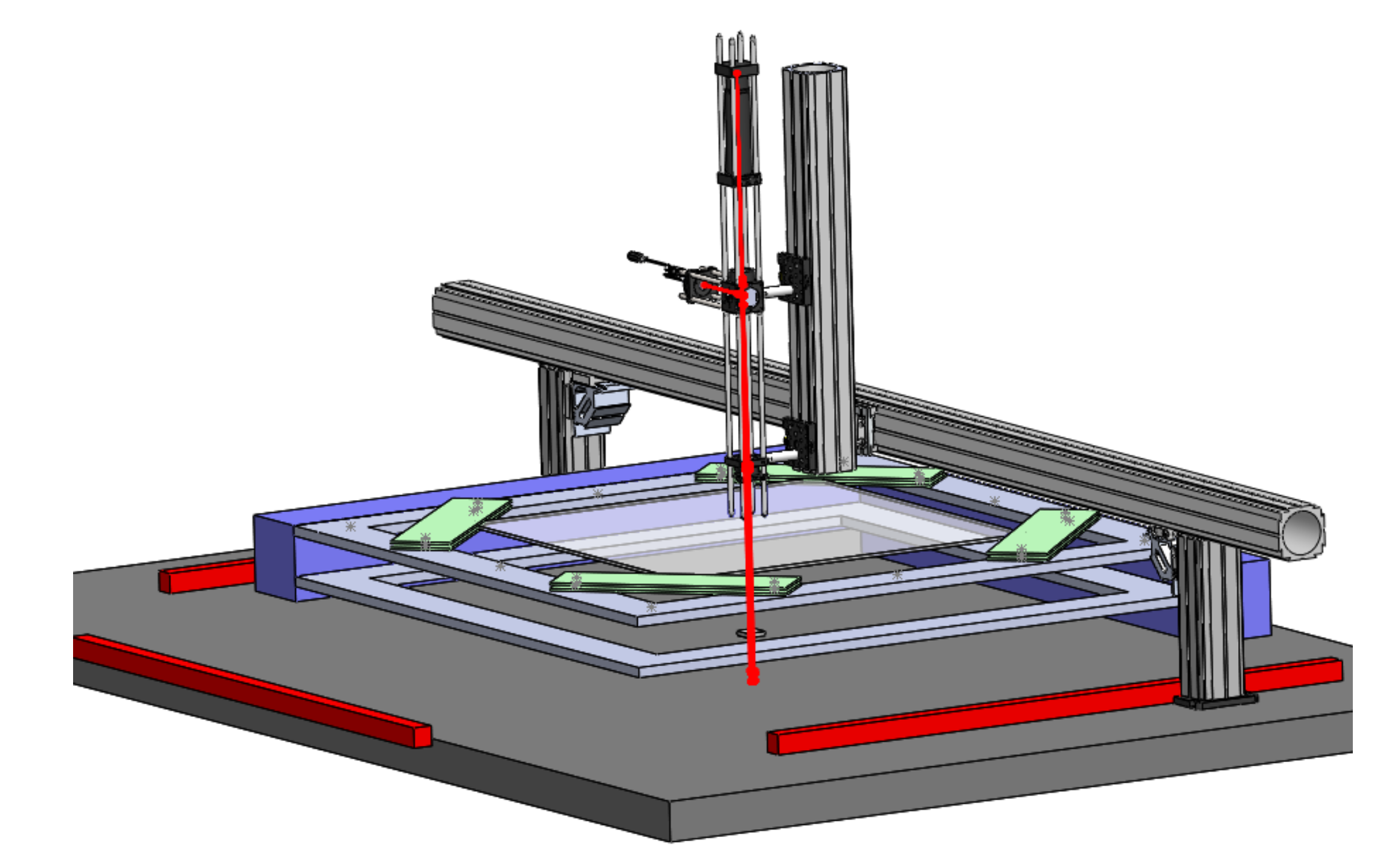
Introduced wavefront Error
An aerospace company is looking for a window to house their ground imaging optics from a LEO satellite.
Determine if a given window is compatible with the corrective capabilities of half the total stroke, 2.75 micrometers, of a Boston Micromachines-5.5 Deformable Mirror (DM).
-
![]()
524 Case Study 3
Remote sensing problem
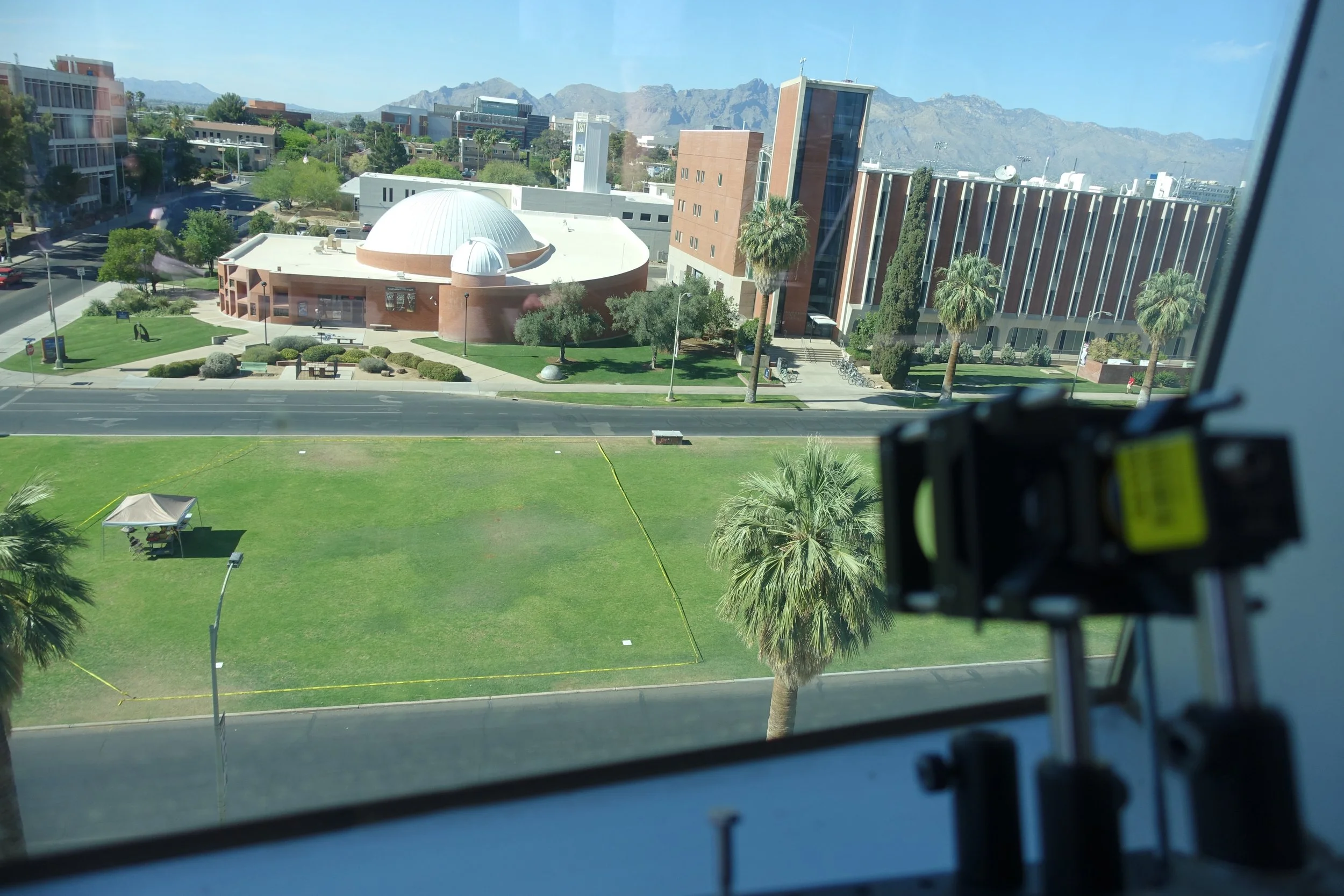
Accurately find and report the location of targets on the UA mall from the 8th floor patio.
Targets range in size from 200mm to 12.5mm.
Two target shapes: square and triangular.
Two target colors: olive green and yellow.
Keep out zone centered around yellow target.